Customer screening meaning at a glance: Customer screening is the mandatory comparison of a potential or existing customer's data against regulatory watchlists and approved risk-intelligence sources to determine their risk profile. It is the defensive barrier used to prevent money laundering, terrorist financing, and sanctions evasion and is a core component of Anti-Money Laundering (AML) and Know Your Customer (KYC) compliance.
In financial crime compliance, precision is the difference between protecting your institution and incurring catastrophic fines.
This glossary provides a guide to the essential terms your team needs to understand how to reduce risk, drive operational efficiency, and move toward safer payments.
What is customer screening in banking and finance?
Customer screening is a non-negotiable step in risk screening and AML compliance. It involves using specialized software to compare identifying information (names, dates of birth, addresses, corporate registration details) against regulatory and proprietary databases.
The primary goal is to prevent financial institutions from engaging with criminals, terrorists, sanctioned entities, or individuals linked to corruption.
Who needs to screen their customers?
Any institution involved in financial transactions is obligated to perform customer screening. This includes:
- Banks and Credit Unions: (Tier 1 banks, regional banks, etc.) The largest user group due to the volume and complexity of transactions.
- Fintechs and Payment Providers: Must screen customers on onboarding and monitor transactions in real time for sanctions risk.
- Insurance Companies and Brokerages: Required for policyholders, beneficiaries, and claimants.
- Corporates: Needed for vendor due diligence and third-party risk management.
When should customer screening be conducted?
Customer screening is never a one-time event; it must be continuous to be effective. The process is usually conducted at two key stages:
- Onboarding (Initial Screening): Performed when a new customer or entity is first engaged. This verifies identity and assesses initial risk exposure before the relationship begins.
- Continuous/Periodic Screening: Performed throughout the customer lifecycle. Since sanctions lists and PEP roles change daily, effective compliance requires ongoing monitoring of the entire customer base to detect newly added risk.
Why risk screening is essential
Customer screening is the primary defense mechanism financial institutions and corporations have against financial crime, regulatory non-compliance, and severe reputational damage. It’s an essential legal requirement.
Types of customer screening
Customer screening in AML
Customer screening AML protocols are fundamental to a bank's defense against financial crime. Screening ensures compliance with global mandates, such as those issued by OFAC (US), the UN, and the EU. By preventing transactions with high-risk individuals, institutions safeguard against involvement in:
- Money Laundering
- Terrorist Financing
- Sanctions Evasion
Know Your Customer Screening
Once a customer's identity is verified (KYC), screening confirms that the verified individual or entity is not present on any adverse lists. Screening turns static identity data into actionable customer risk screening intelligence.
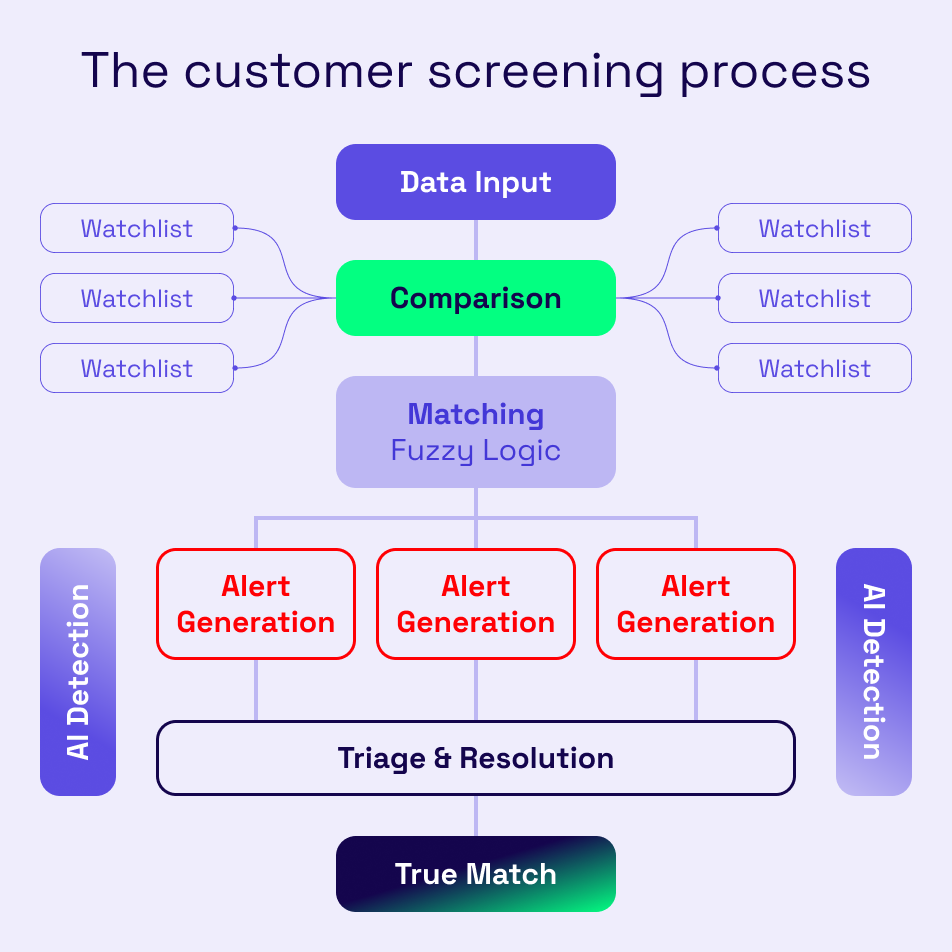
How does the customer screening process work?
The customer screening process is a structured workflow that leverages specialized customer screening technology to manage risk efficiently.
- Data Input: Customer identifying information (name, ID, DOB, address) is collected, fed into the screening system and standardized.
- Comparison: The data is compared against multiple, frequently updated watchlists (Sanctions, PEP, Adverse Media).
- Matching (Fuzzy Logic): The screening technology uses fuzzy logic to identify potential matches even with minor discrepancies (spelling errors, aliases).
- Alert Generation: Any potential match generates an alert.
- AI detection: Explainable AI tools combine machine learning with rule-based logic to evaluate entity screening alerts to reduce the volumes of false positives.
- Triage and Resolution: Compliance analysts investigate the alert.
- Action: The alert is dispositioned as a true match (requiring reporting/blocking) or a false positive (cleared).
Common challenges
Customer screening technology
Modern customer screening software is no longer rules-based. It utilizes customer screening technology powered by AI and machine learning to optimize the process.
Solutions like Eastnet's SafeWatch Screening use integrated AI to refine matching accuracy, dramatically speeding up triage while ensuring industry-leading matching accuracy and reliable detection of true hits.
Customer screening checklist of best practices
To ensure maximum effectiveness, institutions should adopt these practices:
- Continuous Monitoring: Implement a solution that screens the entire customer base against lists in real-time.
- Auditability: Ensure your customer screening software provides clear, time-stamped, and tamper-proof records of every alert and decision made.
- False Positive Reduction: Prioritize technology that integrates AI to achieve a significant reduction, cutting operational costs and reducing watchlist fatigue.
- Data Quality: Maintain high standards for internal customer data to maximize matching accuracy and avoid unnecessary alerts.
- Risk-Based Approach: Dedicate the most scrutiny and resources to customers categorized as highest risk (e.g., international transfers, complex corporate structures).
FAQs about customer risk screening